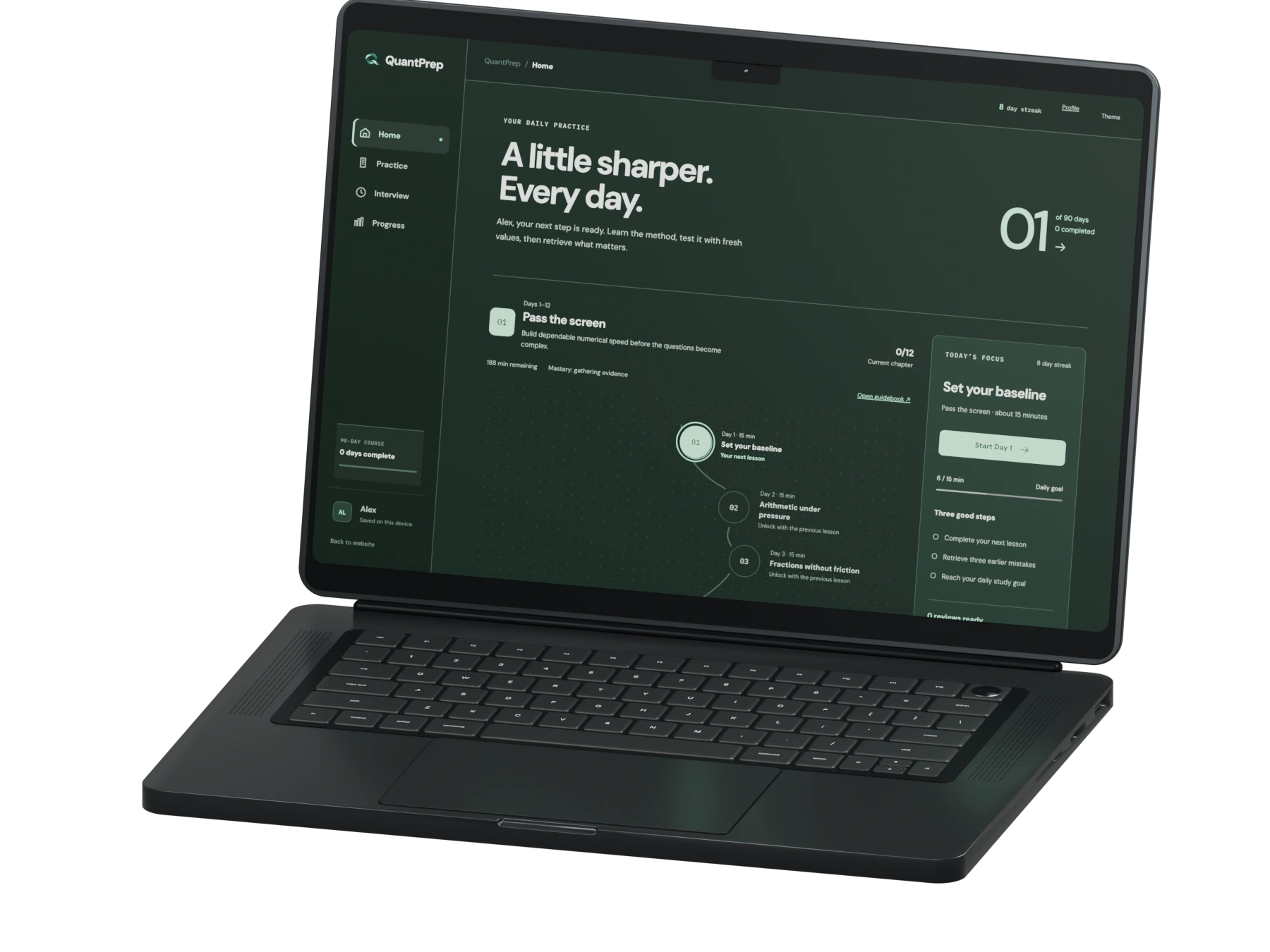
Trading firms filter thousands of candidates with the same families of problems: coin games, dice expectations, Bayes traps, market making quotes, and arithmetic against a clock. Every QuantPrep drill is generated fresh from those archetypes, so you train the method itself. Memorizing answers is impossible.
Train with worked explanations after every question, or sit a strict interview with no feedback until the final report. Correct pays +€100, a miss costs −€50.
Four stages, each testing something different. Know the game before you play it.
Dozens of arithmetic questions against a brutal clock: sums, products, fractions, decimals, sequences. The bar is both speed and accuracy. Most firms penalize wrong answers, so knowing when to skip is part of the skill. This stage eliminates the majority of applicants, so train it daily, like a sport.
Live rounds with a trader or quant covering expected values, conditional probability, combinatorics and classic puzzles. Interviewers care less about the final number than your process. State assumptions, use linearity of expectation, think in complements, and talk while you compute.
"Make me a market on the number of windows in this building." You quote a bid and an ask, then the interviewer trades against you and moves the game. They are testing whether you can price uncertainty, manage a position, update on new information, and avoid getting picked off by a better informed counterparty.
Trading simulations, group games, poker style betting rounds, and behavioural conversations. Firms are checking risk temperament. Are you calibrated, do you size bets to your edge, can you lose a round without tilting, and would the desk enjoy sitting next to you for twelve hours a day?
Six categories covering every classic archetype the trading desks actually use.
Two digit products, squares, fractions to decimals, series sums and powers of two. The raw speed layer every trading firm screens first.
Exact counts, complements, conditional probability, and Bayes' theorem with base rate traps. The core language of trading.
Linearity of expectation, geometric waits, the coupon collector, max and min of dice, and pattern matching coin flips.
Handshakes, committees and arrangements. Fast, structured counting without double counting yourself into a wrong quote.
Implied probabilities, compounding, variance and the Kelly criterion. The bridge from puzzles to real trading judgment.
Gambler's ruin, re-roll decisions and matching problems. The puzzles where interviewers watch how you think.
Proprietary trading and market making firms with famously quantitative interview processes.
Famous for its rapid fire arithmetic screening test: high volume, short clock, penalties for errors. Speed math is non-negotiable here.
Heavy on probability, logic puzzles and trading games, with a strong technology culture across its Amsterdam and Chicago desks.
ETF specialist whose interviews combine numerical testing with market intuition and product knowledge questions.
Boutique options desk. Expect probability, game theory and betting style questions in a small team setting.
The benchmark for probability and market making game interviews: EV puzzles, confidence intervals, and repeated "make me a market" rounds.
Highly quantitative rounds spanning probability, statistics and mental math, plus rigorous technical interviews for quant roles.
Built its identity on decision making under uncertainty. Poker is part of trader training, and interviews probe betting logic and calibration.
Research and technology driven. Quant interviews lean on probability, statistics and algorithmic thinking.
Algorithmic trading firm with mathematically deep interviews covering probability, algorithms and estimation questions.
Broad trading house whose interview loops mix mental math, probability, and market scenario discussions.
Research oriented quant fund. Expect statistics, probability and data driven problem solving over pure speed math.
Known for challenging probability and game theory interviews with a strong competition math flavour.
QuantPrep is an independent study resource and is not affiliated with, or endorsed by, any firm listed above. Interview formats change, so always verify each firm's own process.
Ten questions, real clocks, fresh numbers. See where you stand today.
Start training →